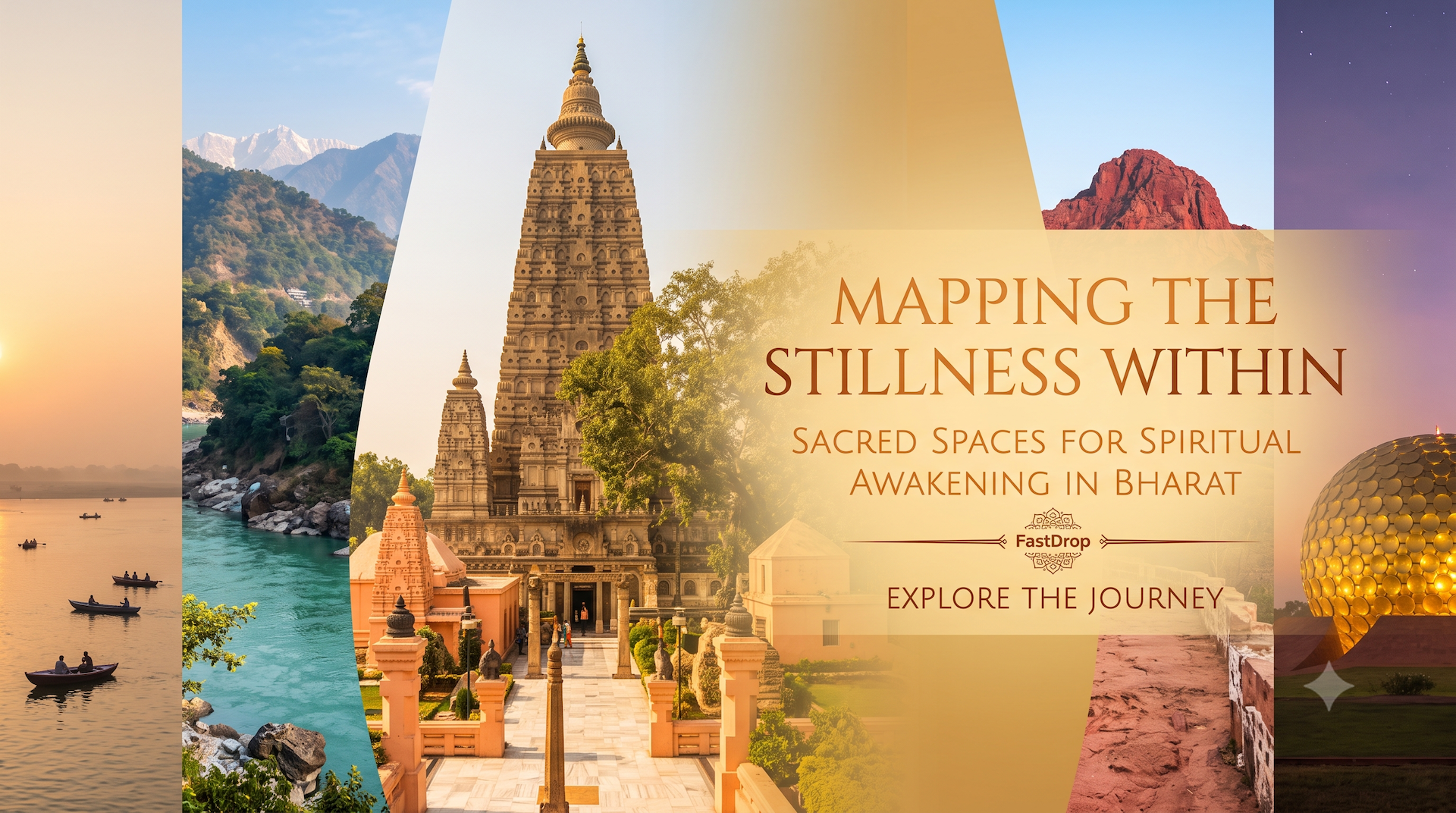
Mapping the Stillness Within: Sacred Spaces for Spiritual Awakening in Bharat
Travel in India has never been merely about a change of scenery—it is an act of return. Explore five profound sanctuaries of transformation across the subcontinent, from the ancient stone spires of Bodh Gaya to the silent granite paths of Arunachala.
On this page
To understand the spiritual geography of Bharat is to understand the concept of a Tirtha—literally a ford, a shallow crossing where a river can be bridged. In the context of inner realization, these are spaces where the veil between the material world and the vast, unmanifest reality becomes whisper-thin.
For the global seeker seeking profound clarity, silent introspection, or a deep resetting of the spirit, these holy grounds are not passive historic markers. They are active vortexes of resonance, charged by centuries of unbroken meditation, ritual discipline, and the footsteps of enlightened masters. Here is a curated guide to five distinct sanctuaries of transformation across the subcontinent.
Varanasi: Meeting Death and Timelessness at the Edge of the Ganga
Kashi—the City of Light—is arguably the oldest continuously inhabited urban center on Earth. Built upon the crescent curve of the sacred river Ganges, it represents the absolute center of Hindu cosmology. It is said that the city rests not on mainland soil, but on the tip of Lord Shiva’s trident, operating outside the laws of linear time.

For a western mind or a first-time visitor, Varanasi can initially present an intense sensory confrontation. The roar of scooters, the ringing of temple bells, and the sight of open-air cremations at Manikarnika Ghat happen simultaneously. Yet, if you sit quietly on a wooden boat at dawn, watching the sun crest the horizon, the chaos falls away into a crystalline quietude. The lesson of Varanasi is radical acceptance: it lays bare the impermanence of the physical body, inviting the soul to wake up to that which never dies.
FastDrop Navigation Note
The best times for silent contemplative walking are between 4:30 AM and 6:30 AM. Avoid the dense crowds by coordinating a guided river approach to the smaller, quieter southern ghats like Assi or Kedar.
Rishikesh and Uttarkashi: The Himalayan Gateway of Prana and Yoga
Where the emerald waters of the Ganga rush out from the tight grip of the lesser Himalayas lies Rishikesh. Long before it gained global fame in the late 1960s, it was the exclusive territory of the Rishis—the seers who transcribed the subtle vibrations of the universe into the Vedas.

The spiritual architecture here is governed by Prana—the fundamental life-force energy. The combination of high-altitude mountain air, mineral-rich river water, and an atmosphere saturated by centuries of silent meditation creates an ideal crucible for internal refinement. If you move further north into the deeper, isolated stretches of Uttarkashi, the spiritual environment intensifies, stripped of all commercial tourism and reduced to the pure elements of stone, sky, and sadhana.
Understanding the Two Distinct Faces of Rishikesh
Swarg Ashram & Ram Jhula: The classic center of traditional monastic institutions. Best for early-morning sanskrit chanting, severe traditional yoga styles, and watching monastic life unfold unchanged.
Tapovan & Laxman Jhula: A modern, globally connected hub offering diverse global healing styles, cafes, and specialized wellness clinics. Ideal for long-term stays and gentle adaptation.
Bodh Gaya: The Ground of Absolute Awakening Under the Bodhi Tree
Around 2,500 years ago, a prince named Siddhartha Gautama sat down upon a mat of kusha grass underneath a native fig tree in Bihar, vowing not to rise until he had pierced through the veil of human suffering. It was here that he conquered the illusions of the mind and became the Buddha.

To sit within the direct proximity of the Mahabodhi Temple is an experience of heavy, stillness. The ground itself feels anchored by an extraordinary density of intent. Monks from every corner of the Earth—Tibet, Sri Lanka, Thailand, Japan—prostrate continuously on wooden boards around the sandstone perimeter. The air is filled with a low, continuous drone of multi-lingual chanting that operates like a subtle mental filter, gently slowing down the busy analytical mind into a deep meditative state.
"Do not seek to follow in the footsteps of the wise. Seek what they sought." — Basho
Tiruvannamalai: The Unmoving Flame of Radical Self-Inquiry
Deep in the dry plains of Tamil Nadu rises the ancient crimson hill of Arunachala. Geologically older than the Himalayas, this weathered granite mountain is revered as Shiva manifested as a column of pure fire. In the twentieth century, it served as the home of Sri Ramana Maharshi, the sage who popularized Advaita Vedanta (non-duality) to the modern world through a simple, uncompromising question: "Who am I?"
Unlike sites that demand complex rituals or deity worship, Arunachala demands silent introspection. The spiritual path here is focused on stripping away mental concepts rather than accumulating new knowledge. Walking the Giri Pradakshina—the 14-kilometer barefoot circuit around the base of the mountain—or sitting in the cave sanctuaries of Virupaksha and Skandashram halfway up the slopes offers an intense experience of pure awareness.

| Contemplative Spot | Primary Quality | Best Practice |
|---|---|---|
| Sri Ramanasramam Samadhi Hall | Deep silence, profound stillness | Silent sitting at dusk |
| Virupaksha Cave | Cool, isolated cave chamber shaped like an 'Om' | Internal breath observation |
| The Outer Mountain Path | Active meditation, grounding earth energy | Barefoot morning walking meditation |
Auroville: The Future Evolution of Human Consciousness
Spiritual awakening in India does not belong solely to antiquity. In the coastal sand dunes of Pondicherry stands Auroville, an international township dedicated to the realization of human unity and the evolutionary philosophy of Sri Aurobindo and Mirra Alfassa (The Mother).

At the physical and spiritual center of this township is the Matrimandir—a massive, golden metallic sphere surrounded by twelve pristine gardens. Inside this architectural marvel lies the Inner Chamber: a stark, white marble room completely devoid of symbols, images, or religious icons. At its exact center rests a single optically pure crystal globe, illuminated by a heliostat tracking a single beam of natural sunlight from the roof. Here, meditation is stripped of dogma, reframed as an evolutionary acceleration towards a higher state of consciousness.
A Practical Field Guide for the Conscious Seeker
Stepping into these highly charged areas requires more than a standard travel itinerary. To ensure your journey supports internal transformation rather than external frustration, keep these guidelines close in mind:
Respecting the Native Rhythms
Sacred places operate on solar and lunar shifts. Align your sleeping schedule to wake up before dawn (Brahma Muhurta). This is the time when the atmosphere is naturally quietest and mental clarity is highest.
Honoring Local Customs
Dress conservatively in loose-fitting clothing that covers your shoulders and knees. Always remove your footwear before entering any temple area, ashram courtyard, or meditation hall.
True spiritual travel requires moving slowly. Rather than trying to visit all five major regions in a single, rushed trip, select one or two locations that call to you most clearly. Spend at least a full week in each place to let the subtle environment settle into your nervous system.
The Ultimate Journey is Inward
The geography of Bharat acts as a mirror. The temples, the ancient trees, the silent mountains, and the sacred rivers do not give you something new; they simply reveal the stillness that has always lived inside your own chest.
Comments
Loading comments…